Choosing a waterfront lot on Johns Island can feel exciting until you realize how many details hide behind the view. A beautiful marsh edge or tidal creek frontage may look perfect at first glance, but the real value often comes down to dock feasibility, flood profile, and whether the lot can actually support the home you want to build. If you want to buy with confidence, you need to know what to check before you fall in love with the scenery. Let’s dive in.
Start With the Water Type
Not all Johns Island waterfront lots offer the same experience. In this part of the Lowcountry, the kind of water you are buying often matters more than the street name or the listing description.
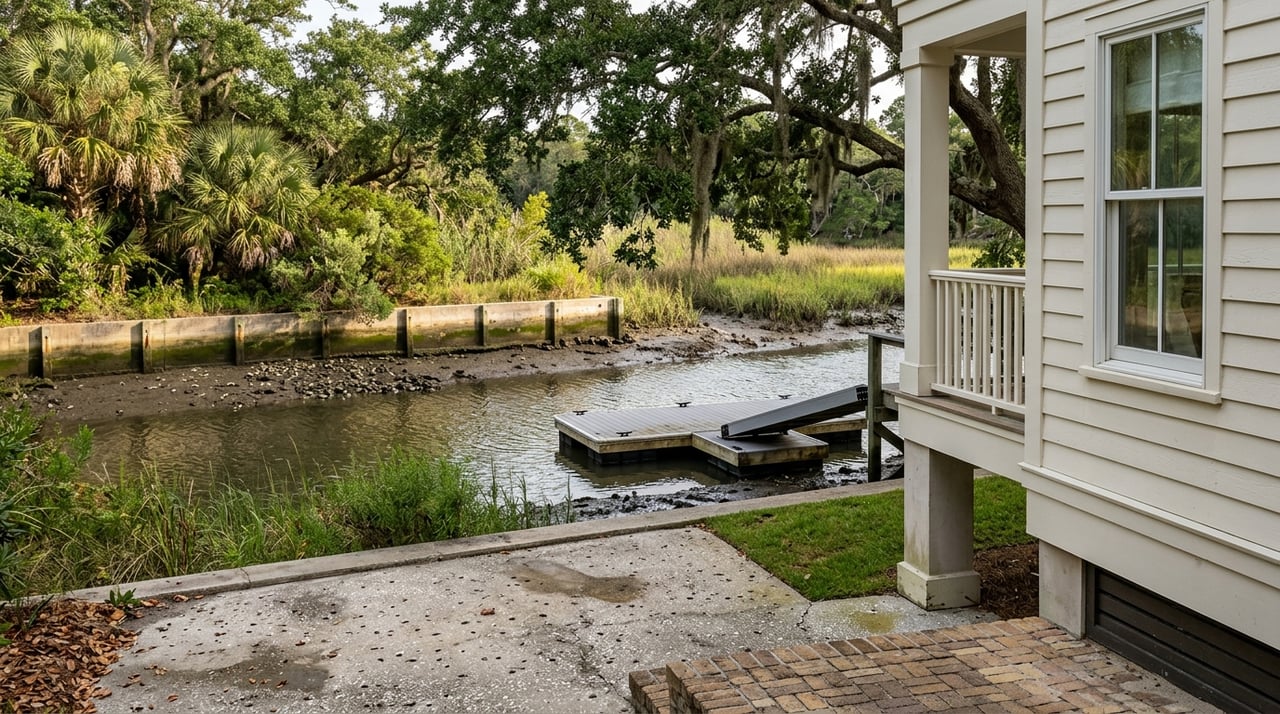
Tidal creeks, marsh frontage, and more exposed coastal settings each come with different tradeoffs. According to the South Carolina Department of Natural Resources, tidal creeks and salt marshes are important habitat areas, and some tidal creeks can be nearly dry at low tide. That means a lot that looks ideal on a high-tide showing may function very differently day to day.
Marsh-front lots
Marsh-front parcels often stand out for wide views, natural surroundings, and a strong sense of place. If your goal is to enjoy the landscape and the rhythm of the coast, this type of lot can be a great fit.
The key caution is simple: marsh frontage does not automatically mean dock access. A buyer should treat views and dock potential as two separate questions.
Tidal-creek lots
Tidal-creek lots often attract buyers who want boating access. In many cases, these lots offer the best chance for a private dock, but only if the creek width and permit path support it.
This is where Johns Island buyers need to be especially careful. A creek can be narrow, shallow, or otherwise limited in ways that affect whether a dock is practical or even permitted.
Check Dock Feasibility Early
One of the most important decisions you can make is to stop asking, “Does this lot have water access?” and start asking, “Can this lot realistically support a dock?” Those are not the same thing.
In South Carolina, SCDES Coastal Management regulates critical areas such as coastal waters and tidelands. Activities like docks, floating docks, boat lifts, bulkheads, footpaths, and pierheads can trigger permitting review. If work is below the mean high water line in tidal waters, a Construction in Navigable Waters permit path may also apply.
Ask about a Dock Master Plan
If the lot is in a subdivision, ask whether the community has a Dock Master Plan, or DMP. SCDES says a DMP is only a guide, not a guarantee of approval, but it is still an important part of the due diligence process.
If there is no DMP, the agency still reviews the lot under site-specific requirements. Either way, you should never assume a dock is possible based on marketing language alone.
Creek width matters
On Johns Island, creek width is one of the biggest practical limits on dock potential. SCDES measures width as open water from marsh grass to marsh grass.
Their current guidelines are:
- 10 feet or less: no dock structures
- Under 20 feet: generally no dock structures unless specific circumstances exist
- 20 to 50 feet: 120 square feet
- 51 to 150 feet: 160 square feet
- More than 150 feet: 600 square feet
SCDES says this square-foot calculation includes fixed pier heads, floating docks, boat lifts, and boat storage docks. It does not include the walkway, ramps, catwalks, or mooring piles.
Review the permit file
If a seller says a lot is dockable or already permitted, ask to review the permit file. Confirm whether the permit is active, whether it can be transferred, and whether the planned dock features match what was approved.
SCDES notes that active permits can be transferred, but work must be completed within five years of issuance. Major additions, such as floating docks or expanded pier heads, usually require an amendment or a new permit.
Use this dock checklist
Before you make an offer, ask for:
- The dock permit file
- Any Dock Master Plan documents
- Active permit status
- HOA or ARB rules
- Any related local or agency approvals already obtained
SCDES also notes that other approvals may still be needed from local government, an HOA, an architectural review board, or the Army Corps. The safest move is to confirm the full path before you price the lot like a true dock property.
Understand Flood Risk Before Design
Flood risk affects more than insurance. It can shape construction standards, elevation decisions, and long-term ownership costs.
FEMA’s official flood maps identify Special Flood Hazard Areas, including A-type and V-type zones such as AE and VE. On Johns Island, many waterfront lot questions center on flood classification, elevation, and how close a parcel sits to a flood-zone boundary.
Zone X does not mean no risk
A common mistake is assuming Zone X means you are in the clear. FEMA states that moderate- and low-risk areas can still flood, and nearly 1 in 4 NFIP claims occur outside high-risk areas.
That is why flood due diligence should go beyond the label on the map. If a lot sits near a boundary or the map appears off, there may be reason to explore a formal map review process.
Work with county flood resources
For unincorporated Johns Island parcels, Charleston County floodplain staff can issue flood-zone determination letters. The county also keeps elevation certificates on file for new construction and substantial improvements.
Those records can help you understand what may already exist for a parcel and what additional work may be needed during planning.
Price insurance realistically
Flood insurance is usually separate from homeowners coverage. FEMA says most homeowners policies do not cover flood damage, and flood insurance policies typically have a 30-day waiting period.
That matters if you are buying close to the water and trying to budget accurately. Premiums are influenced by the property’s flood characteristics, including elevation, distance from the water source, storm surge exposure, erosion exposure, and rebuild cost.
Buildability Is Bigger Than Lot Size
A waterfront lot may look spacious on paper and still have a limited buildable envelope. On Johns Island, zoning, stormwater rules, septic feasibility, setbacks, and buffers all shape what you can actually do.
For unincorporated Johns Island parcels, Charleston County zoning rules work together with county stormwater requirements and SCDES review where applicable. The result is that lot usability often becomes clear only after a careful site review.
Stormwater can affect the timeline
Charleston County classifies Johns Island as a Stormwater Special Protection Area. The county states that development in these areas must follow county stormwater standards, and a stormwater permit is required before a building permit can be issued.
The county also says a stormwater permit is required for land disturbance over 5,000 square feet. In addition, zoning permits may be needed for work such as grading, filling, clearing, driveway construction, surfacing, grubbing, and tree removal.
Septic may decide the deal
If a lot is not served by public sewer, septic feasibility can become the make-or-break issue. SCDES says soil suitability is the most important factor in septic review, and some permits are denied because the soil is not suitable.
The agency also notes that locating suitable soil takes priority over the location of the house and outbuildings. In practical terms, that means your dream house placement may need to adjust to the septic reality of the site.
Setbacks and buffers reduce usable area
Two waterfront lots with similar views can support very different home designs. That is because zoning district rules, critical-line setbacks, and buffers can shrink the usable footprint.
Charleston County’s zoning tables show that some waterfront standards include a 50-foot OCRM critical-line setback and a 35-foot buffer, while other standards vary by district and utility service. This is one reason lot width, access, and layout matter just as much as raw acreage.
Trees can shape the site plan
Tree protection rules may also affect what you can build and where. Charleston County advises owners to contact zoning before removing or encroaching on trees, and Grand and Protected Tree rules can influence site design.
If you are planning a custom home, you want to know early whether the lot still has room for the house, parking, utilities, outdoor living, and required retained trees after all constraints are counted.
Renovation Lots Need the Same Caution
Some buyers focus on vacant land, while others look for older waterfront properties they can renovate or replace. On Johns Island, those projects still require careful review.
Charleston County defines substantial improvement as work over any five consecutive years that reaches 49 percent or more of a structure’s market value. On a flood-prone waterfront parcel, crossing that threshold can turn a renovation into a flood-compliance project.
If you are considering a remodel, review the flood zone, elevation documentation, and permit history before you commit. A property that looks like a cosmetic opportunity may involve a much bigger compliance path.
Match the Lot to Your Goal
The best Johns Island waterfront lot is not always the most dramatic one. It is the one that lines up with how you actually want to use the property.
If boating is your priority
Focus on real dock potential first. Check creek width, permit history, and whether the lot has a credible path through SCDES review.
If views are your priority
A marsh-front lot may offer the setting you want. Just make sure you are comfortable if dock access is limited or not feasible.
If building is your priority
Put flood, stormwater, septic, setbacks, and tree constraints at the center of your due diligence. A lot only works if the home you want still fits after those requirements are applied.
If renovation is your priority
Treat existing improvements as only part of the story. Confirm how renovation thresholds, flood compliance, and permit history may affect your plans.
Make Tradeoffs on Purpose
Buying waterfront on Johns Island is often about balancing four big variables: the water body, dock rights, flood profile, and buildable area. When those four align, a lot can be an excellent fit.
When they do not align, the right answer depends on your priorities. A strong buyer decision comes from understanding those tradeoffs before closing, not after plans are already in motion.
If you are weighing waterfront opportunities on Johns Island and want a partner who understands how acquisition, lot evaluation, and the build process connect, King & Society Real Estate can help you move with more clarity from the start.
FAQs
What should you check first on a Johns Island waterfront lot?
- Start with the water type, then evaluate dock feasibility, flood zone, and buildable area before relying on the listing description.
Can every Johns Island waterfront lot have a dock?
- No. Dock feasibility depends on site-specific factors such as creek width, permitting, subdivision Dock Master Plan status, and other approval requirements.
Why does creek width matter for a Johns Island dock?
- SCDES uses creek width guidelines to determine whether dock structures may be allowed and how much dock square footage may be permitted.
Does a Zone X flood designation mean a Johns Island lot has no flood risk?
- No. FEMA states that moderate- and low-risk areas can still flood, so you should still review the flood map, insurance options, and site conditions carefully.
Why is septic so important on Johns Island waterfront land?
- If public sewer is not available, SCDES approval for septic is required before the county can issue a building permit, and soil suitability can determine whether the site works at all.
What can limit the buildable area on a Johns Island waterfront lot?
- Zoning district rules, stormwater requirements, critical-line setbacks, buffers, septic layout, driveway needs, and tree protection rules can all reduce the usable footprint.